The figure known as Lucifer has captivated theological imagination for millennia, yet much of what people believe stems from artistic tradition rather than Scripture itself. Pop culture, medieval art, and centuries of folklore have shaped a devil with horns, red skin, and a pitchfork, an image that has almost nothing to do with the Hebrew text.
Examining the biblically accurate Lucifer means separating this cultural imagery from the original Scripture, tracing how a single Hebrew word became the name “Lucifer,” and understanding how pride corrupted perfection into rebellion. This article uncovers the true story behind the biblically accurate Lucifer, exploring what Isaiah, Ezekiel, and centuries of translation actually reveal.
Biblically Accurate Understanding of Lucifer’s Identity
Understanding the biblically accurate Lucifer starts with translation history, since the name appears only once in most English Bibles.
Common Misconceptions About Lucifer in Modern Culture
Pop culture rarely matches the biblically accurate Lucifer:
- Never described as red-skinned or horned in the Bible
- Automatic equation with Satan comes from tradition, not scripture
- Horns, hooves, and bat wings originate from medieval art
- The red devil costume traces back to Victorian opera
What Scripture Actually Reveals About Lucifer
Isaiah 14:12 is the only verse in most translations naming “Lucifer,” describing a fallen morning star. Ezekiel 28:12-17 offers a companion image, an anointed cherub of perfect beauty addressed to the King of Tyre. Whether both passages describe the same being remains scholarly debate, which is exactly why the biblically accurate Lucifer is harder to pin down than tradition suggests.
The Hebrew Original: Helel and Its True Meaning
The Hebrew word behind “Lucifer” is Helel (הֵילֵל), from the root halal, “to shine” or “to boast.” The full phrase, “Helel ben Shachar,” means “shining one, son of the dawn,” a reference to Venus fading before sunrise.
Jerome’s Latin Vulgate and the Birth of “Lucifer”
Jerome translated Helel into Latin as “Lucifer,” from lux (light) and ferre (to bear), the Roman name for Venus. Turning a title into a proper name planted centuries of confusion.
King James Translation and English Christian Tradition
The 1611 King James Version kept Jerome’s Latin word instead of “morning star.” Modern translations like the NIV and ESV render Helel as “morning star” to stay closer to Hebrew.
Biblically Accurate Description of Lucifer’s Appearance
Scripture describes his original glory in detail but says almost nothing about his appearance after the fall. This gap sits at the center of any biblically accurate Lucifer description.
Lucifer’s Pre-Fall Glory According to Ezekiel
The biblically accurate Lucifer, per Ezekiel 28:12-15, is “the seal of perfection, full of wisdom and perfect in beauty,” adorned with nine precious stones.
| Attribute | Biblical Description |
| Status | Seal of perfection |
| Intellect | Full of wisdom |
| Adornment | Nine precious stones, set in gold |
| Position | Anointed guardian cherub |
The Morning Star Imagery in Isaiah’s Prophecy
Isaiah’s morning star metaphor emphasizes trajectory: Venus outshines every star before fading at dawn, glory that cannot sustain itself.
Does Lucifer Possess Physical Form After His Fall?
Ephesians 6:12 suggests he operates beyond flesh and blood, while 2 Corinthians 11:14 warns he can “masquerade as an angel of light.”
What Biblical Silence Tells Us Lucifer Is Not
The Bible never mentions red skin, horns, a pitchfork, or a tail. These come from medieval folklore and Renaissance theater, not from any biblically accurate Lucifer text.
Symbolism and Meaning Behind Lucifer’s Role in Biblical Texts
Lucifer as a Symbol of Pride and Rebellion
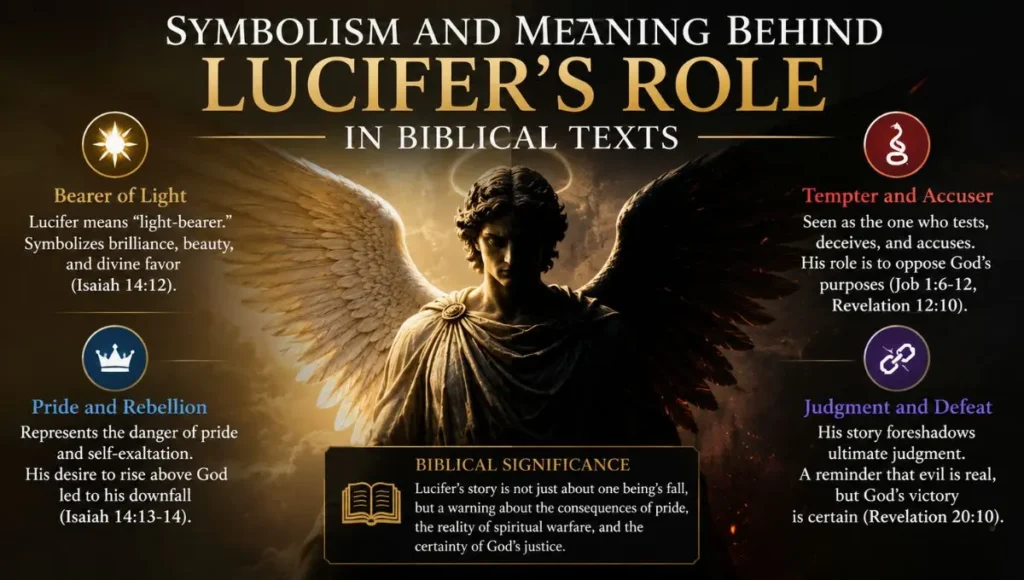
Beyond appearance, the biblically accurate Lucifer symbolizes what happens when a created being credits itself for gifts it never earned.
The Spiritual Meaning of His Role in Scripture
Isaiah and Ezekiel use cosmic language for a human problem: pride convincing the gifted they deserve worship instead of gratitude.
How Biblical Symbolism Shapes Christian Understanding
This reading is why his fall is taught as a warning to believers, not simply angelic history.
Read Also: 444 Meaning Bible: Discover God’s Divine Message in Numbers
Critical Distinction Between Lucifer and Satan in Scripture
Many assume Lucifer and Satan are one figure, but a biblically accurate Lucifer reading draws a subtler line than tradition suggests.
Biblical Evidence Supporting Their Distinction
“Lucifer” appears once, translating “Helel.” “Satan” appears 58 times, meaning “adversary.” In Job 1:6-12, “the satan” is a role in God’s council, not a name tied to Ezekiel’s proud cherub.
| Aspect | Lucifer | Satan |
| Meaning | Shining one | Adversary |
| Frequency | Once (KJV) | 58 times |
How Christian Tradition Merged These Figures
Origen of Alexandria first read Isaiah 14 and Ezekiel 28 as Satan’s fall. Dante and Milton cemented the merger in popular imagination.
Protestant Reformers’ Rejection of the Equation
John Calvin called the Satan reading of Isaiah 14 an error rooted in ignoring context. Luther agreed, insisting it addresses a human king.
Why This Theological Distinction Matters Today
Respecting context keeps interpretation honest, turning the biblically accurate Lucifer into a universal warning against pride rather than a tale about one villain.
Biblically Accurate Account of Lucifer’s Fall and Significance
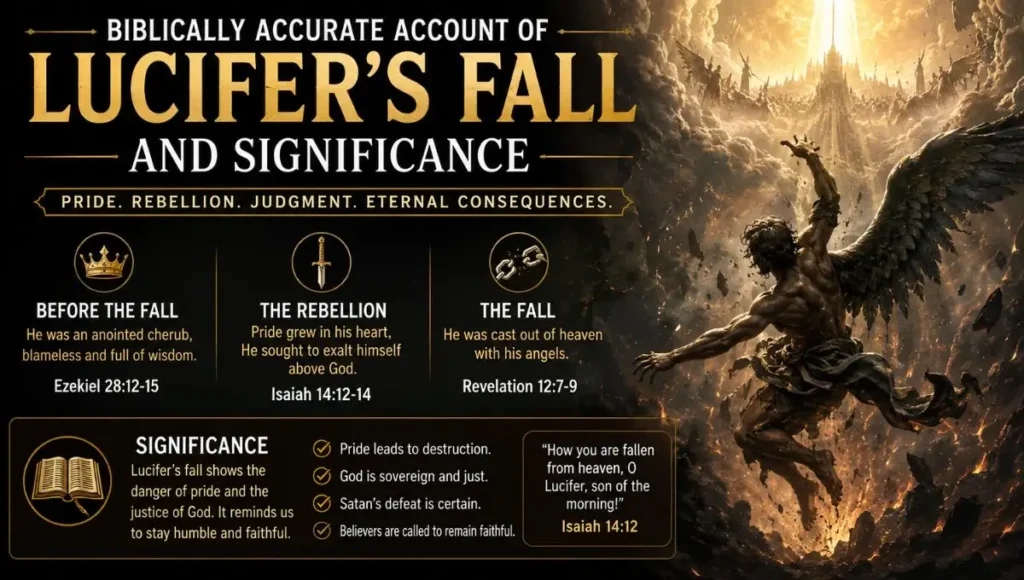
The fall itself is where the biblically accurate Lucifer story turns from glory to tragedy.
The Narrative of the Fallen Angel in Scripture
Ezekiel 28:15 marks the turning point: “until unrighteousness was found in you.” In the biblically accurate Lucifer story, perfection gave way to corruption from within.
Lucifer’s Five “I Will” Declarations of Pride
Isaiah 14:13-14 lists five escalating claims:
- “I will ascend to heaven”
- “I will raise my throne above the stars of God”
- “I will sit enthroned on the mount of assembly”
- “I will ascend above the tops of the clouds”
- “I will make myself like the Most High”
The Nature of Sin: Pride in God-Given Perfection
Ezekiel 28:17 diagnoses the cause behind the biblically accurate Lucifer’s fall: pride over his beauty corrupted his wisdom. The gift became the idol.
Catastrophic Consequences of Angelic Rebellion
Isaiah 14:15 describes being “brought down to the realm of the dead,” a reversal from the highest heaven to the lowest degradation.
The Scope of Rebellion: One-Third of Angels
Revelation 12:3-4 describes a dragon sweeping a third of the stars from the sky, read as angels joining the rebellion.
Artistic Evolution of Lucifer’s Image Throughout History
Art has reshaped the biblically accurate Lucifer far more than most people realize, moving through several distinct eras.
Early Medieval Period: The Ethereal Blue Angel
Byzantine art used blue to signal divine origin, portraying him as beautiful, indistinguishable from other angels except by context.
High Medieval Transformation to Grotesque Forms
By the 14th century, plague and upheaval pushed art toward grotesque, bat-winged figures, popularized by Dante.
Renaissance Romanticization: Milton’s Tragic Rebel
Milton’s Paradise Lost (1667) reimagined him as a charismatic anti-hero, later painted by Blake and Doré.
Victorian Era Through Modern: The Theatrical Red Devil
Gounod’s opera Faust (1859) popularized the red-costumed devil for stage visibility, the image behind today’s costume.
Contrasts Between Artistic and Biblical Portrayals
Scripture emphasizes internal corruption and lost wisdom; art emphasizes external monstrosity. This gap is exactly why the biblically accurate Lucifer requires returning to the original texts.
Read Also: 27+ Beautiful Forearm Half Sleeve Bible Verse Tattoos
Theological Insights from a Biblically Accurate Lucifer
These theological threads are why the story still matters far beyond angelology.
The Paradox of Created Perfection and Free Will
A perfect being could still rebel because free will requires the real possibility of choosing wrongly.
The Origin of Evil Within a Perfect Being
Unlike human sin, the biblically accurate Lucifer’s corruption arose entirely from within, evil as a turning away from good.
Pride’s Specific Temptation: Giftedness and Position
Ezekiel 28:17 ties the downfall to beauty and wisdom, gifts meant for service that became tools for self-exaltation.
Cosmic Implications: Corrupting Others and Spiritual Warfare
Personal pride rarely stays personal. A third of the angelic host reportedly followed him, and 1 Peter 5:8 pictures ongoing opposition.
Lessons for Humanity: Humility and Dependence on God
Romans 12:3 calls believers to sober self-assessment, the opposite of the biblically accurate Lucifer’s five declarations of pride.
FAQ’s
What did Lucifer look like according to the Bible?
The biblically accurate Lucifer was perfect in beauty, covered in nine precious stones, with no mention of horns or wings.
How does the Bible describe the fall of Lucifer?
Isaiah 14 and Ezekiel 28 describe pride corrupting his wisdom, leading to expulsion from God’s holy mountain.
Is the portrayal of Lucifer in Hazbin Hotel biblically accurate?
No, it’s a fictional reinterpretation with no direct grounding in Isaiah or Ezekiel.
Who is Lucifer in the Bible?
He is the figure named once in Isaiah 14:12, traditionally linked to a proud, fallen angelic being.
How is Lucifer described in the KJV Bible?
The KJV calls him “Lucifer, son of the morning” in Isaiah 14:12, keeping Jerome’s Latin name instead of “morning star.”
What does a biblically accurate demon look like?
Scripture gives no consistent physical description of demons, focusing instead on their deceptive spiritual activity.
What does the Bible say about the appearance of Michael the Archangel?
Scripture gives no physical description of Michael beyond his role as a warrior archangel.
What would a biblically accurate depiction of Jesus look like?
Isaiah 53:2 suggests an ordinary, unremarkable appearance, with no scriptural support for common artistic depictions.
Summary
The biblically accurate Lucifer is not the red-horned monster of popular culture but a Hebrew poetic figure built from one word, Helel, “shining one.” Isaiah 14 and Ezekiel 28 describe beauty and wisdom undone by pride, while Jerome and the King James Version shaped English tradition around the name.
Understanding the biblically accurate Lucifer means recognizing what tradition added. Horns and a pitchfork come from medieval art and Victorian theater, not scripture, and Reformers like Calvin and Luther rejected the automatic equation with Satan. Strip away the artistic layers, and what remains is a story about pride, free will, and mistaking a gift for a possession.

Welcome to Inspiredwordz! I’m M Abdullah. Christian Faith Writer | 6+ Years Bible Study Experience | Founder of (Inspiredwordz.com)
Sharing prayers, Bible Name Meaning and biblical wisdom to strengthen your faith.